
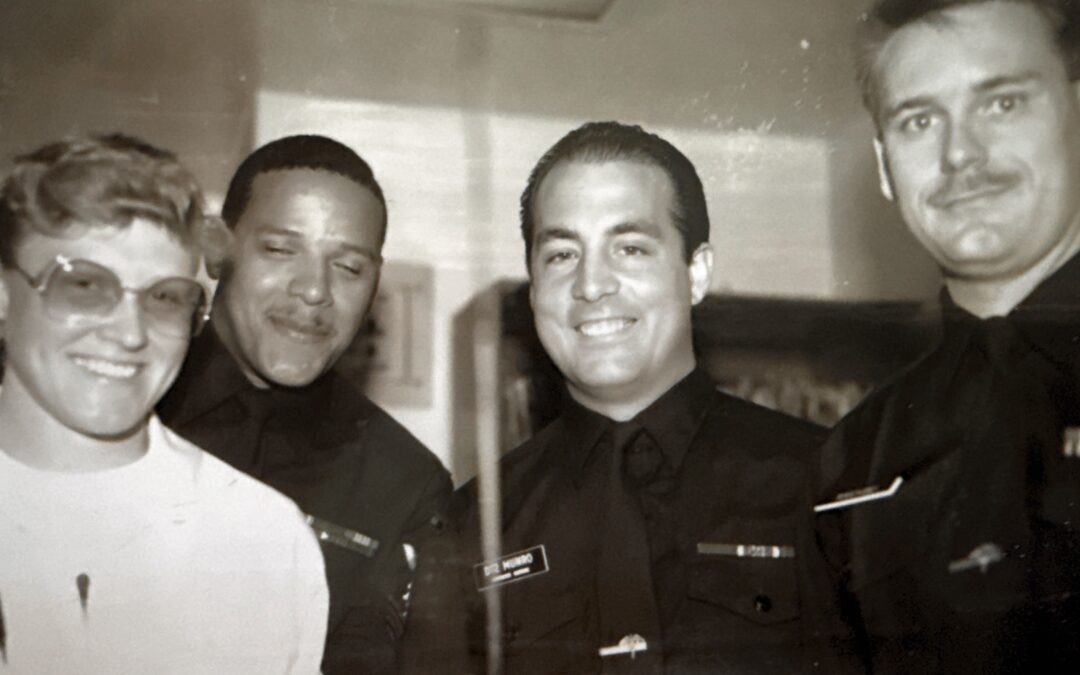
It’s 1989. I’m 27 years old. Finally, the day has come—I officially feel like an adult.
It’s not a good feeling.
Right now, I’m stationed at Naval Hospital Long Beach and I’m miserable. I’m working as an oral surgery assistant, which means I spend most days on my feet, sucking blood and spit, handing instruments to the surgeon. Every Wednesday is operating room day. O.R. cases can go five to eight hours. You learn quickly not to drink anything the night before—or that morning. It’s as if you’re the one lying naked on the table. No bathroom breaks. No smoke breaks. No food. Your legs, back, shoulders, forearms, wrists, fingers, neck, and feet all ache. I had no idea what it was doing to my hips. Twenty-two years from now, both will be replaced with titanium.
 Me with my co-workers. Fun fact. That’s my wife Barb on the far left. Steve Kerr, me, and Larry Marchand.
To make it worse, the surgeon—and his colleague, who he brings over from the Long Beach shipyard clinic—are complete assholes. When they get frustrated in the OR, one or both yells and throws instruments. Best part? When theyscrew up—snap off a root tip or something—they look at me like it’s my fault.
But work is only one of the headaches. I’m in class four nights a week at Long Beach Community College, and every other weekend with Southern Illinois University, desperately trying to piece together a college degree. I don’t want to stay in the Navy, but I don’t really know how to do anything else. My degree is in Health Care Management, which doesn’t interest me, but I’m banking on the idea that any degree is better than none. Still, I’m tired. And discouraged.
Then there’s my young family. My daughter is 3, my son barely one. My wife stays home with both kids—which saves us on daycare—but with only one income, things are tight. We do our shopping every two weeks after military payday. Once we’ve hit Price Club, Stater Brothers, Fedco, and filled the car with gas, I might have $20 left to get us to the next check. It’s stressful. And when you pile that on top of work and school, it’s overwhelming.
And then, of course, there’s family. I took orders back to California so we could be near both our families. What I didn’t realize was how much I had changed after nearly five years overseas. I’d grown up. I didn’t want to do the same silly stuff I used to when I was a kid dating my wife. But she felt that separation. She was still close with her family and missed them desperately when we were away. After four years overseas, she wanted to catch up. Her sisters and brother lived nearby, and they were over constantly—usually uninvited. Family became overwhelming.
One Tuesday night, I pulled into the driveway after class at 10:20 PM. I was exhausted, and I knew I had to be in the OR the next morning. As I drove up to the house, I saw the living room curtains open, and there she was—my wife, her sisters, her brother—dancing and goofing around. I was so frustrated I just parked down the street and sat in the car for an hour, completely out of gas emotionally. At the end of my wits.
Being an adult isn’t fun. I don’t know why I rushed through childhood thinking it would be better than this—but it’s a mess. What was I thinking?
This is adulthood. That feeling of hopelessness in the face of endless years of work. Of working for the man.
It’s like hitting the wall during a marathon. Even if you train, it still hits you. When I used to teach management courses, I called that point Phase 3—when you want to quit and walk away.
But somehow, I kept going. I went through a divorce. Dated a while. Remarried. Moved overseas. Had two more kids. Finished a BS and MA. Got out of the Navy. Started a business. Got out of debt. And then, one day, I looked in the mirror and saw an old bald man staring back at me.
And honestly—I don’t remember how I did it. I wish I could write it down, hand it to my kids, and say: Here’s how you get through it.
Because now, our two grown kids are hitting that same wall.
They’ve got good jobs. They make good money. But even with all that, they say the same things I used to. They wonder how they’re supposed to grind away at this forever. They worry about the economy. The country. The future. And when they ask how we survived it, how we figured it all out—I have no answer.
We just did. Just like our parents did. Just like their parents before them. One day, life just becomes a predictable, numbing rhythm. You cope. You adjust. You move forward. And one day, they’ll get through it too. And like me, they won’t be able to explain how.
But now, at 61, I’m feeling that uncertainty again. Even though I’m in the best shape I’ve been in 15 years, 61 is a long way from 26. I’ve got wisdom now—but I worry about how long I’ll have it.
It’s the uncertainty of aging. Watching my mom deteriorate from Alzheimer’s. My father-in-law from dementia. My dad died from ALS. I worry about that. I have energy and creativity now, but what happens if the economy tanks? I’m good at pottery and writing—but what happens if I get Parkinson’s?
It feels like I’m hitting another wall. The wall of senior adulthood. And all the uncertainty that comes with it.
Senior adulthood feels the same and different. The same in anxiety. Different in energy—I have far less of it now.
My kids can pry knowledge from this old geezer. But I don’t have many people left to ask about my own fears. Not many around who’ve gone through what’s next. And so, I guess, like before, I’m just going to have to figure it out on my own.
Just like I did at 27.
Where are you on your journey?
Who’s helping you along the way?