
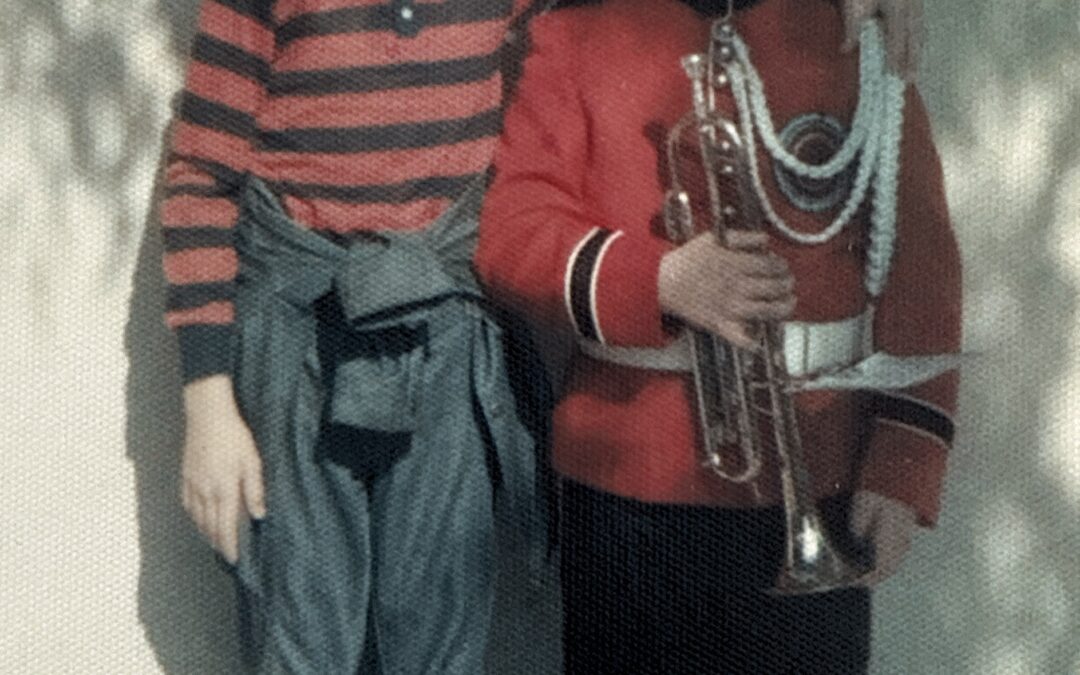
In 1976, when I was in sixth grade, I fell in love with music. I was in a music appreciation class, and we were exposed to classical music. It wasn’t new to me—my dad listened to it, along with vintage country music on KLAC, 570 on the AM dial. My favorites were marches by John Philip Sousa and the William Tell Overture by Rossini.
I begged my parents to let me take music lessons. They were more than happy to support me and asked what instrument I wanted to play. I chose the trumpet. Every Thursday at 4 p.m., I took a 30-minute lesson with Walter Palmer at Wynn’s Music in Tustin.
Mr. Palmer was probably in his 40s. He had a huge mustache and could play multiple instruments. I brought him a check for five dollars each week, and he taught me new notes and techniques, encouraging me to practice an hour a day.
At first, it was fun—and I was good. I went to a Lutheran K–8 school, and our music teacher, Ms. Pat O’Tera, encouraged me. She was organizing a marching band for the Santa Ana Christmas Parade. We didn’t have enough students, so she partnered with a Catholic school—The School of Our Lady. Kind of ironic for Lutherans and Catholics to march together, considering their storied past. Probably wouldn’t happen today.
Playing in a band was fun. The marching part? Not so much. I had no idea I’d be marching again a few years later in Navy boot camp. Whatever joy I found in it disappeared once it became mandatory—all day, every day, for eight weeks.
It made me want to play other instruments. I wanted to be like Ms. O’Tera. Well, not exactly like her—she was significantly overweight, and both she and her tiny Ford Pinto were covered in cat hair. But I admired how she could pick up any instrument, wipe off the mouthpiece, and just play.
Since playing trumpet meant I could play other brass instruments like the French horn and flugelhorn—and I’d already mastered all the notes and fingerings—I asked my parents if I could take violin lessons. That way, I could learn strings next. Woodwinds would follow.
That was the plan.
My parents disagreed. They wanted me to focus on just one thing. Eventually, I lost interest. I wouldn’t pick up the trumpet again until 1985, when I was overseas and volunteered to play in a quartet, going Christmas caroling with a bunch of other sailors. After that, I never had the desire again.
When I launched my management training and consulting business, I was so excited I took on any project—regardless of whether I was interested or even qualified. I was supremely confident and had no problem faking it until I made it. It didn’t take long before I mastered a bunch of different disciplines and skill sets.
Work was fun. Each client was different. Some needed help with outplacement and résumés. Others wanted basic management training. A few asked for conflict resolution sessions. Some needed help with performance management systems or process improvement. I felt like a handyman—good at many things. And unlike my Navy days, no two days were the same.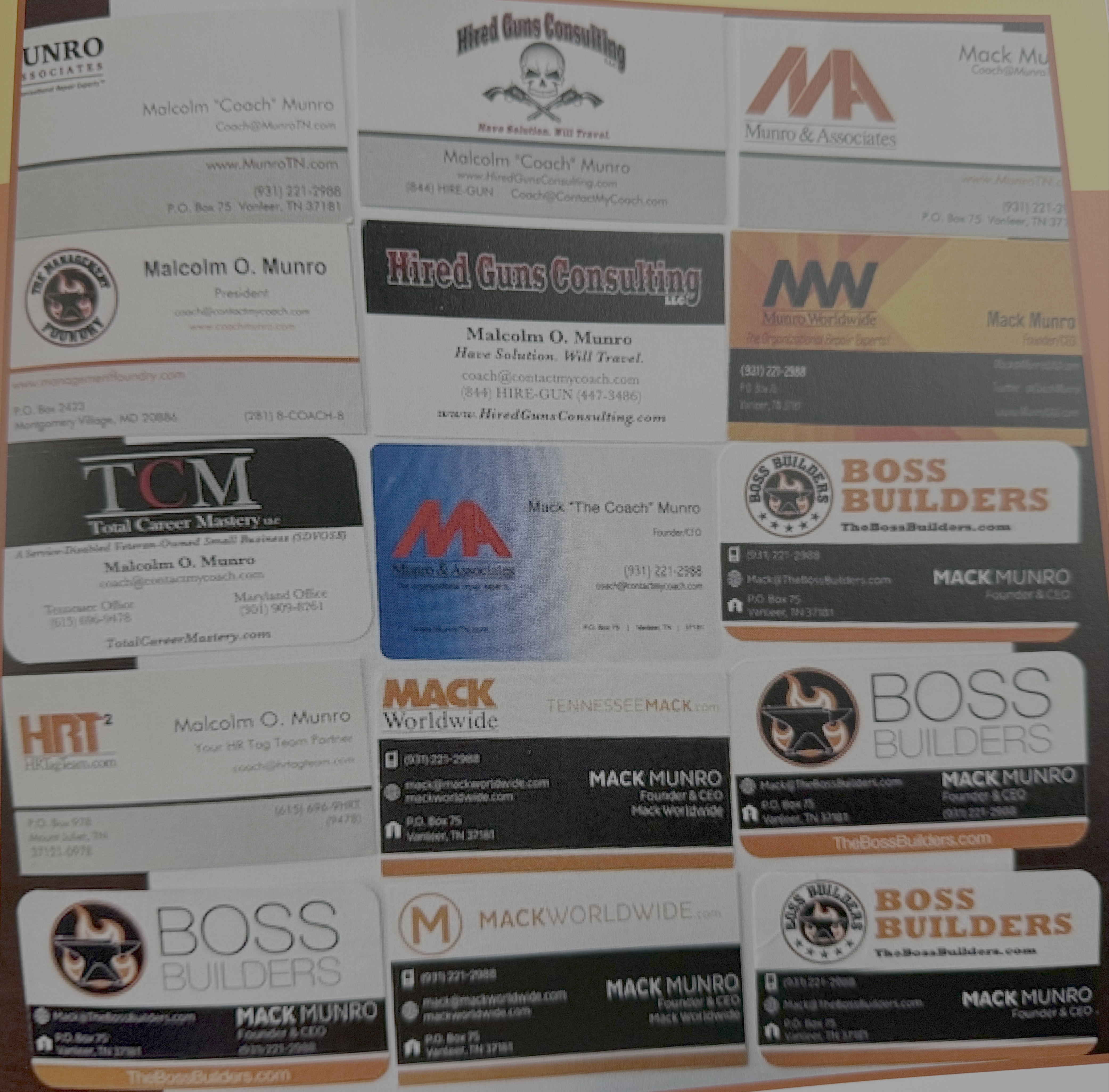
One of the best parts was changing brands. I’ve operated under numerous DBAs over the years. I guess wearing the same clothes and doing the same job every day for 15 years in the Navy made me go a little crazy. Just look at some of my brands.
In 2018, I felt pressured to narrow my focus. My wife had been after me for years. Lisa Young too. At the Tennessee State SHRM conference in Nashville that year, both Barb and Lisa told me: pick a name and stick with it. That’s when Boss Builders was born.
Then came the hard part—figuring out my specialty. Apparently, that’s the secret to scaling a business.
I worked with a business coach for a year and followed all his advice.
But it didn’t feel like me.
I was asked to get in a box—and stay there.
Don’t get me wrong. I liked the box. I just didn’t like the idea of living the rest of my work life in it.
I doubled down on the focus and came up with a marketing pitch:
I work with frustrated HR professionals who are tired of their team leads, managers, and supervisors underperforming.
So focused. So narrow. An inch wide and a mile deep. That’s the recipe.
For regular people, anyway.
Remember—I’m the guy who wanted to play every musical instrument known to man. If my parents had let me, I might be a didgeridoo virtuoso by now.
Just like I was put in a box back then, I felt my spirit boxed in now. I started turning down work that genuinely interested me—all so I could stay focused on my “one thing.” I did everything they told me to do. But I wasn’t happy anymore.
Especially when that “one thing” dried up.
I loved doing workshops. I still love training. But the forced focus took a lot of that joy away.
Of course, none of this really matters now. I’m retired from that career. But I’ve learned to listen to the real me—the one who nerded out on a Sousa march, the kid who wanted to play every musical instrument, the musician who could appreciate vintage country, classical, or whatever sounded good. Someone who would never thrive in a box, a uniform, or a singular cause.
That’s the real me.
And in this next—and final—career, I’ll do whatever I damn well please. If I want to play the kazoo, I’ll do it. If I feel like teaching a workshop on storytelling, nobody’s holding me back.
It took me 61 years to figure out who I really am. But now that I know, I’m aligning everything to that.
What about you?
What box are you living in?
Are you comfortable? Good.
But how stable is that box?
How long will you be safe there?
I’m learning more about myself every day.
What are you learning?